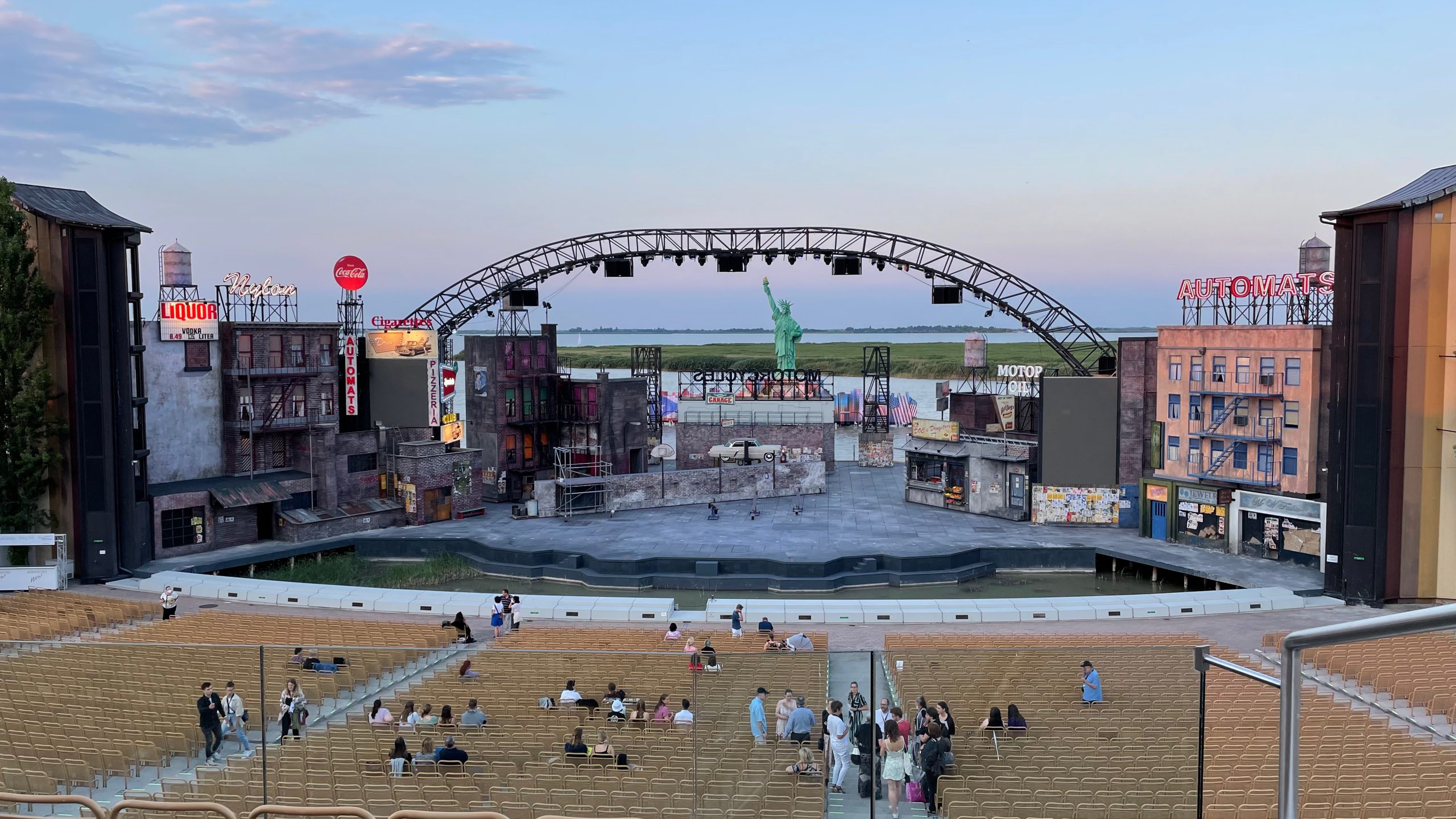
A stage is already charged with meaning long before the first scene begins.
It holds anticipation, traces of labor, constructed streets, hidden pathways, technical processes, and the stories that are about to unfold.
For the Seefestspiele Mörbisch, the stage of West Side Story was therefore activated before the performance itself. It became a space that audiences could enter, explore, and experience from within.
The guiding question was simple:
What changes when a production is not only anticipated from the audience seats, but entered before it begins?
Using their own smartphones and headphones, visitors moved through the musical’s stage set and auditorium. The New York of the 1950s was not only visible—it became audible. Between streets, facades, and architectural elements of the set, voices emerged, revealing different layers of the place.
A police officer speaks about the city’s tense gang conflicts. Leonard Bernstein and his wife discuss the creation of the musical. Stage technicians share the challenges of working on such a large-scale production. Musicians offer glimpses into the life behind the performance. Maria, Tony, Anita, and Riff appear in a stylized conversation drawn from the world of the musical. Longtime festival visitors contribute their own memories of Mörbisch, while festival founder Herbert Alsen learns from his wife Gisela how the festival has evolved over the years.
The result is not a conventional guided tour, but a polyphonic prelude to the performance.
Visitors enter a threshold space: no longer simply audience members, yet not quite inside the performance itself. The stage and auditorium become a place where fiction, production realities, music history, and audience experience intertwine.
This is where the project’s unique atmosphere emerges. The set begins to reveal itself. Walking through it, visitors gain a sense of the many layers, professions, stories, and preparations that must come together before an evening on stage can begin.
West Side Story transforms the time before the performance into an experience of its own.